
Iapetus is Saturn’s third largest moon with a diameter of 1,472 km. It has been suggested that like Rhea, Iapetus is 75% water ice and 25% rock. It orbits nearly 3.5M Km from Saturn and this great distance froom the planet’s tidal forces has allowed the moon to remain relatively unaffected by resurfacing so it is very heavily cratered. Images have revealed large impact basins, at least five of which are over 350 km wide. The largest has a diameter of 580 km, its rim is very steep and includes a scarp about 15 km high. Iapetus is known to support long-runout landslides, possibly supported by ice sliding. The moon has a bulging wasteline and squashed poles.
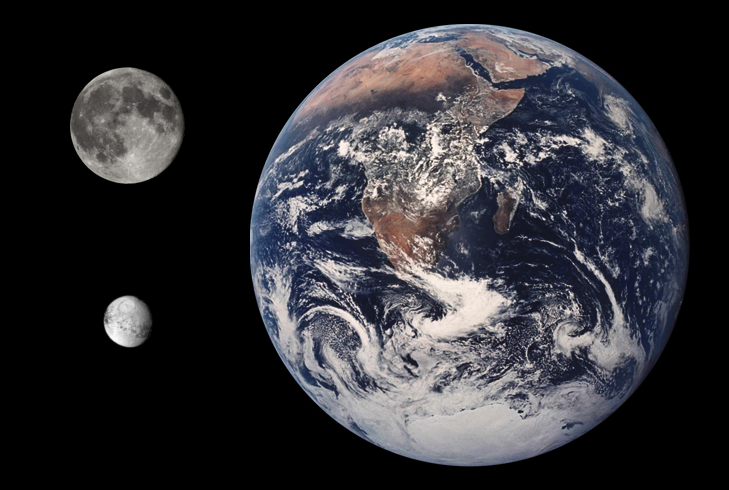
Iapetus is interesting because one hemisphere is very bright and the other is dark. It could be that the moon is hoovering up dark particles shed by another moon, Phoebe. Another theory is that there might be ice volcanism distrubting darker material on the surface. Eruptions of hydrocarbons might form the dark surfaces, although it contains hydrcarbons similar to those found on the surface of comets or some meteorites. This is likely exaggerated by thermal segregation. Iapetus has a very slow rotation, more than 79 days and such a slow roation means that the daily temperature cycle is very long with perhaps the biggest differences in temperate of all of Saturn’s moons. This means that the dark part of the moon absorbes more heat from the sun which causes the lighter coloured material to migrate to the cooler parts.
Another notable feature of Iapetus is a chain of 10 km high mountains around the equator with peaks of up to 20 km which makes these mountains among the highest in the solar system. It could be that they were formed when the moon was rotating more quickly or they could be material left from the collapse of a ring. The ridge is heavily cratered which suggests that it is very old and it follows the equator almost exactly. In any case, this ridge of mountains around the middle makes the moon look a bit like a walnut!
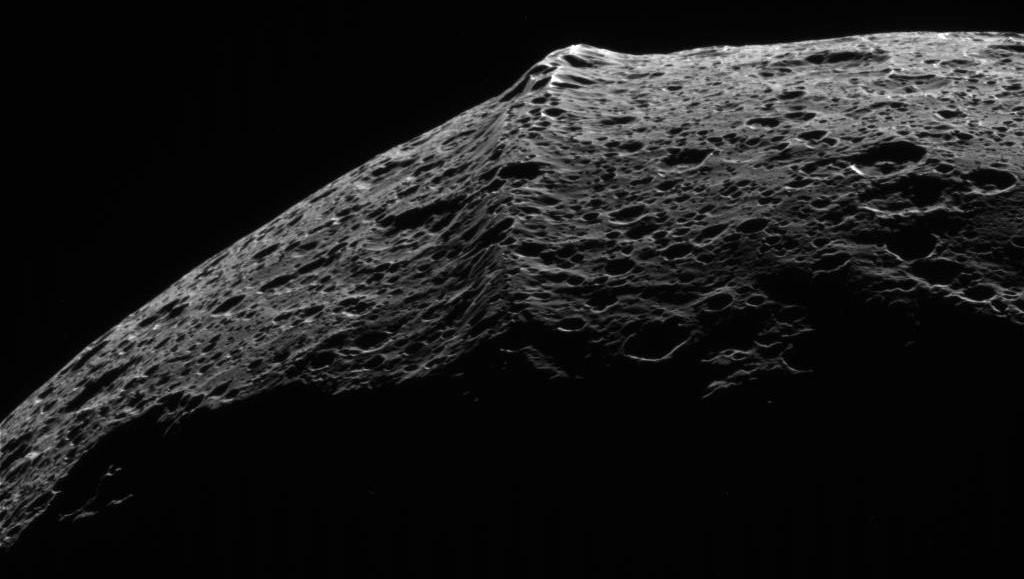
A close-up of the ridge around the equator.