Tethys is Saturn’s fifth largest moon with a diameter of 1,066 km. It is similar to the larger moons of Dione and Rhea but is not as heavily cratered. This is likely due to the fact the moon is relatively close to Saturn, at a distance of 294,660 km which means that Saturn’s tidal influence is likely to have kept the moon active for longer. The average surface temperature of Tethys is -187 degrees C.
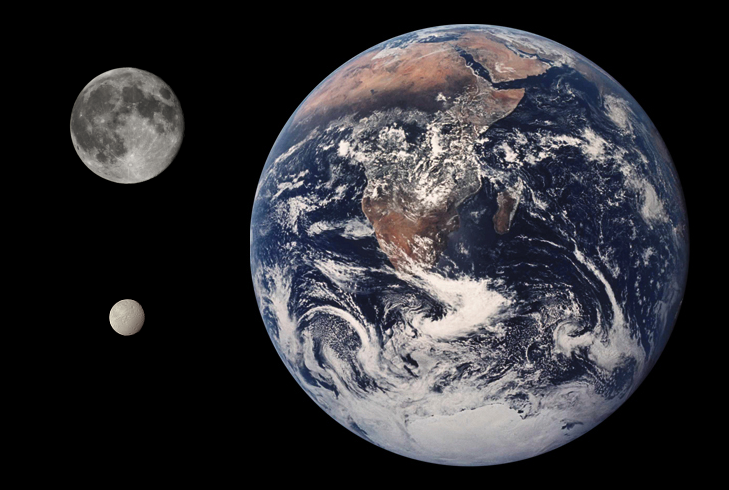
Tethys has a low density of 0.98g/cm3, the lowest out of all the major moons in the solar system which suggests it is made almost entirely out of ice with no rocky core. This is also apparent in that the surface of the moon is very bright, second only to Enceladus.
As with the similar moons the surface is heavily impacted by craters. There are two outstanding features, however, both on the western hemisphere. There is one huge impact crater called Odysseus crater which is 400 km in diameter, and around two fifths the size of Tethys itself! Such an impact could have shattered a solid body which suggests the moon might have been at least partly molten at that point.
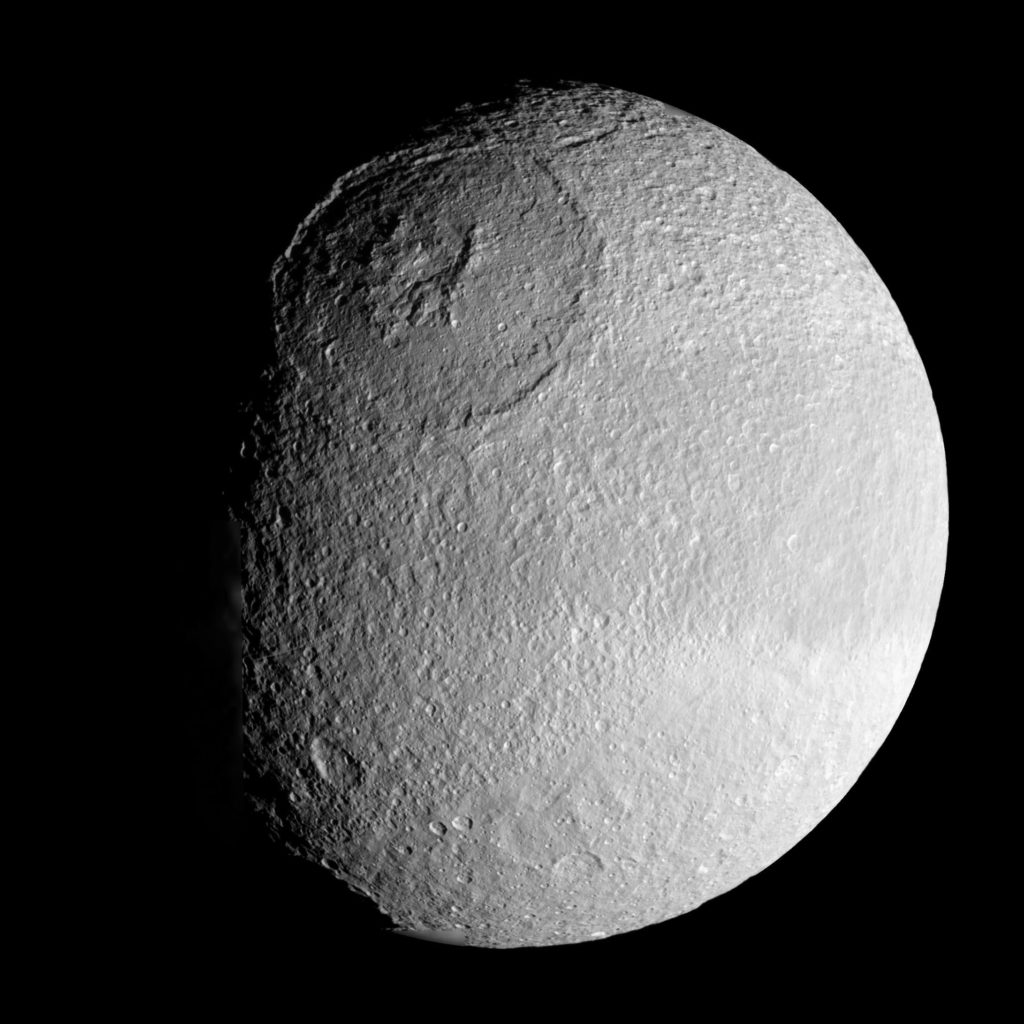
The second major feature is a valley called the Ithaca Chasma, extending 2,000 km from the north to the south pole. It is 100 km wide and up to five km deep. The chasma may have been formed by the expansion of internal liquid water as it froze into ice after the surface had already frozen. A second theory is that the impact that created the Odysseus crater also created the Ithaca chasma, which seems plausible as it is on the opposite side to the crater.