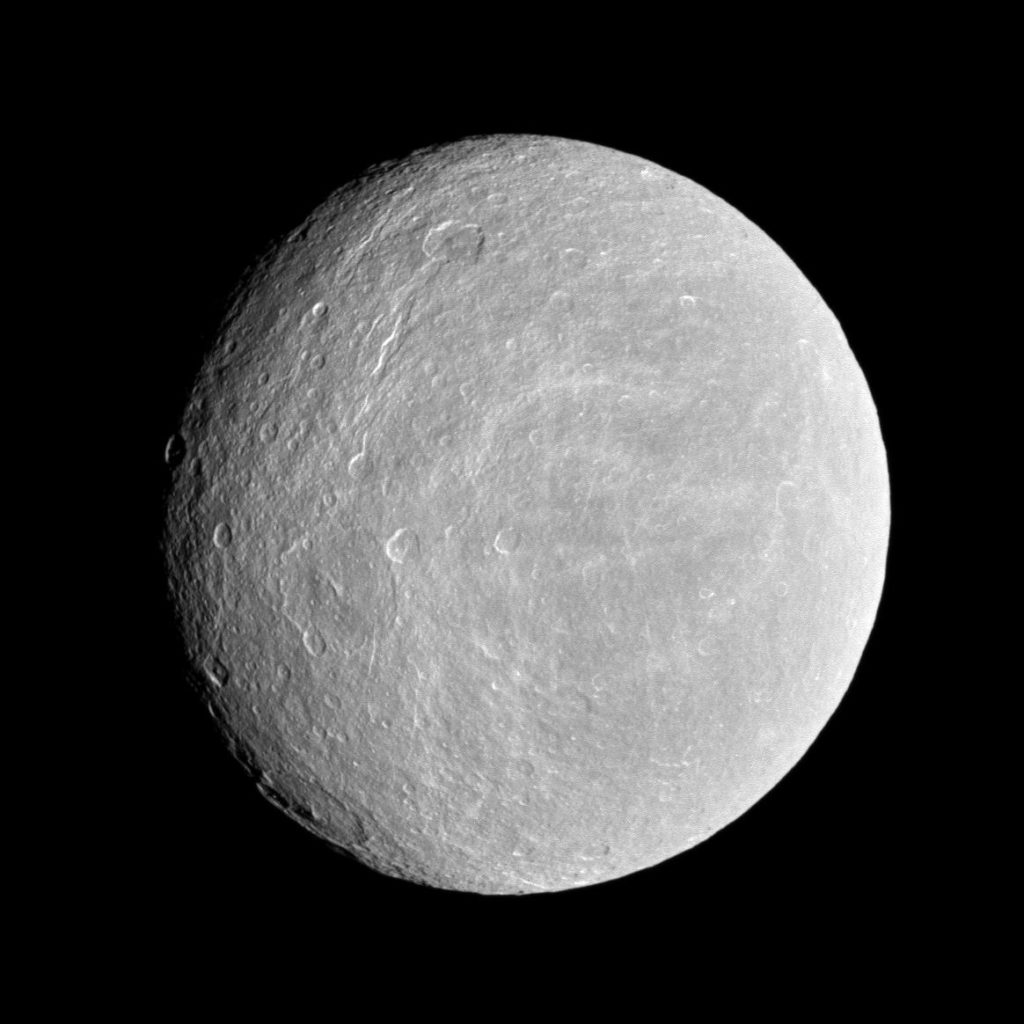
Rhea is the second largest of Saturn’s moons but with a diameter of 1,529 km it is less than a third of the size of Titan. Rhea is 527,000 km from Saturn , further away than Dione and Tethys so it does not receive ample tidal varition from Saturn to cause internal heating. With very little atmosphere the surface temperature ranges from -174 degrees C to -220 degrees C depending on whether it is getting any sunlight. The surface composition is largely water ice which acts like rock under these temperatures.
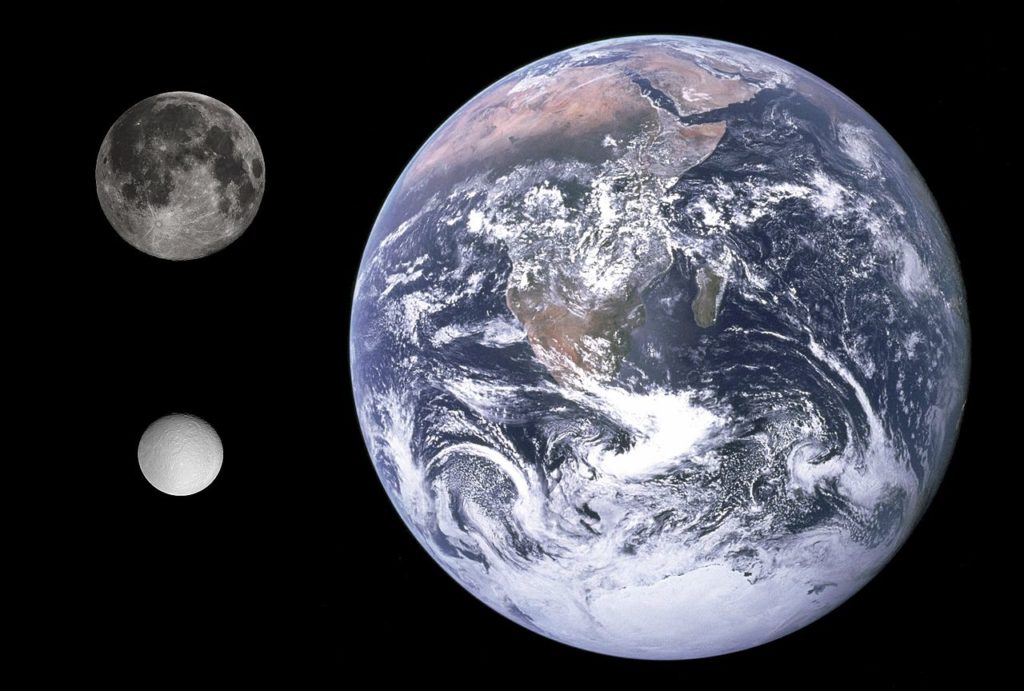
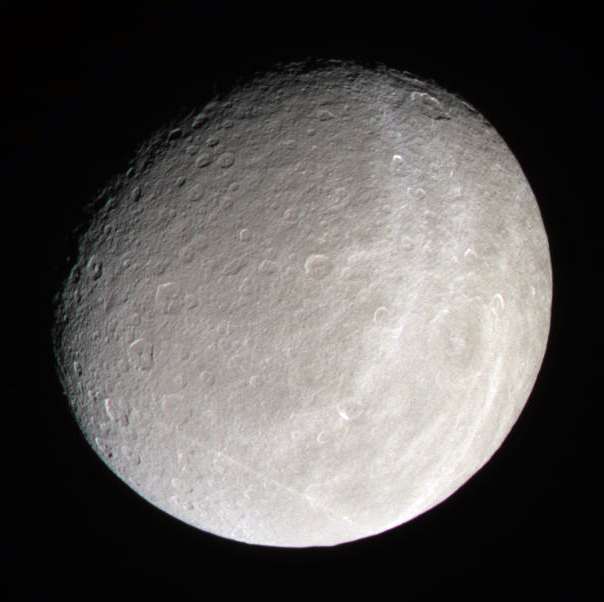
It is thought that Rhea is made up of 75% ice and 25% rock but it does not appear to have a rocky core and has been likened to a big, frozen, dirty snowball! The moon is very heavily cratered, more so than other similar moons of this size and this is likely to be due to lack of internal heating meaning that the craters are not erased by eruptions from inside Rhea. As well as many impact craters, the surface of Rhea also has subsidence fractures that make canyons, some of which are several hundred metres high. This suggests that Rhea may have been tectonically active in its past.
Rhea does actually have a very thin atmosphere, consisting of Oxygen and Carbon Dioxide which was detected by the Cassini probe in 2010. Although very thin, this was the first time Oxygen molecules were detected in an atmosphere by a spacecraft other than on Earth. This oxygen arises when Saturn’s magnetic field rotates over Rhea when particles from the planet hit the moon’s surface. This causes chemical reactions that release the oxygen. The source for the Carbon Dioxide is not known but may be related to oxidation of the organics present in ice or to outgassing of the interior.
The Cassini probe also detected a faint ring system around Rhea, which was the first time this was found orbiting a moon.