
It’s fair to say that although all of Saturn’s moons have their own interesting features, most of them are fairly similar, being inactive balls of rock and ice. There are two glaring exceptions. Titan, with its thick atmosphere and active chemistry, with the other being Enceladus.
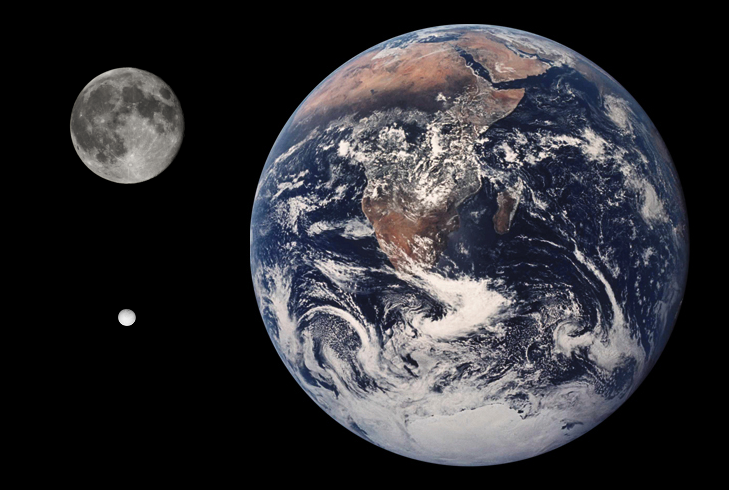
Enceladus is a small moon, only 505 km in diameter which makes it smaller than the UK but it is the most reflective body in the solar system. It is an active moon with a salty liquid ocean beneath its crust. Jets of icy particles from that ocean containing water and simple organic chemicals are firing out into space. It shoots out at around 800 mph and forms a plume that extends hundreds of miles into space. Some of this material falls back down to the surface but some escapes to form Saturn’s E ring.
The cassini probe discovered that the E ring was made up mostly of ice droplets but it also contained silica nanograins that can only be produced in an environment where liquid water and rock intact at temperatures of 90 degrees C. This points to the existence of hydrothermal vents deep within Enceladus, similar to those that exist on the ocean floor on Earth.
The mechanism that drives and sustains the eruptions is thought to be tidal heating. The intensity of the eruption of the south polar jets varies significantly as a function of the position of Enceladus in its orbit. The plumes are about four times brighter when Enceladus is at the point in its orbit most distant from Saturn. This is consistent with calculations which predict the south polar fissures are under compression when Enceladus is closer to Saturn, pushing them shut, and under tension when further away, pulling them open. Much of the plume activity consists of broad curtain-like eruptions. The extent to which cryovolcanism really occurs is a subject of some debate, as water, being denser than ice by about 8%, has difficulty erupting under normal circumstances. At Enceladus, it appears that cryovolcanism occurs because water-filled cracks are periodically exposed to vacuum, the cracks being opened and closed by tidal stresses.
When Cassini analysed the contents of the water jets it found a mix of water vapour, volatile gasses, carbon dioxide, carbon monoxide and organic materials. The density of organic materials was about twenty times what was expected. The underground water ocean is thought to be about ten km deep beneath the southern polar region under an ice shell up to 40 km thick. Further analysis in 2019 was done of the spectral characteristics of ice grains in Enceladus’s erupting plumes. The study found that nitrogen-bearing and oxygen-bearing amines were likely present, with significant implications for the availability of amino acids in the internal ocean. The researchers suggested that the compounds on Enceladus could be precursors for “biologically relevant organic compounds. If life exists outside Earth in our solar system then this underground ocean is one of the most likely habitats to sustain it.
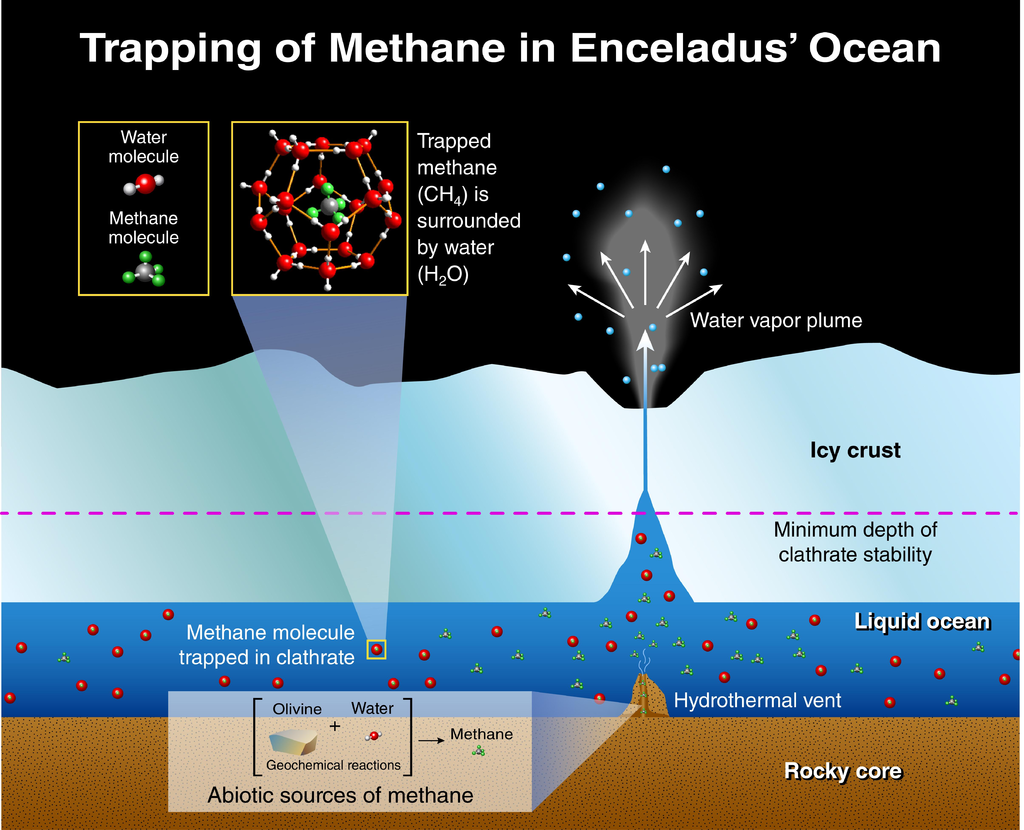
Another feature of Enceladus is that it is quite dense which suggests that unlike many of Saturn’s moons which are made up mainly of ice, Enceladus has a relatively large rocky core.
There are a number of interesting tectonic features on the surface of Enceladus including troughs, scarps, grooves and ridges. The canyons are up to 200 km long and 10 km wide with a depth of about 1 km. These are geologically young as they cut across other features and have sharp topographic relief. There are also bands of grooves and ridges cutting across planes which are crudely aligned rather than the more regular ones seen on Jupiter’s moon Ganymede. Given the level of resurfacing seen on Enceladus it is clear that tectonic movement has been an important driver of geology for much of its history.